Nalanda’s Astronomy: Mapping Universe Without Telescopes
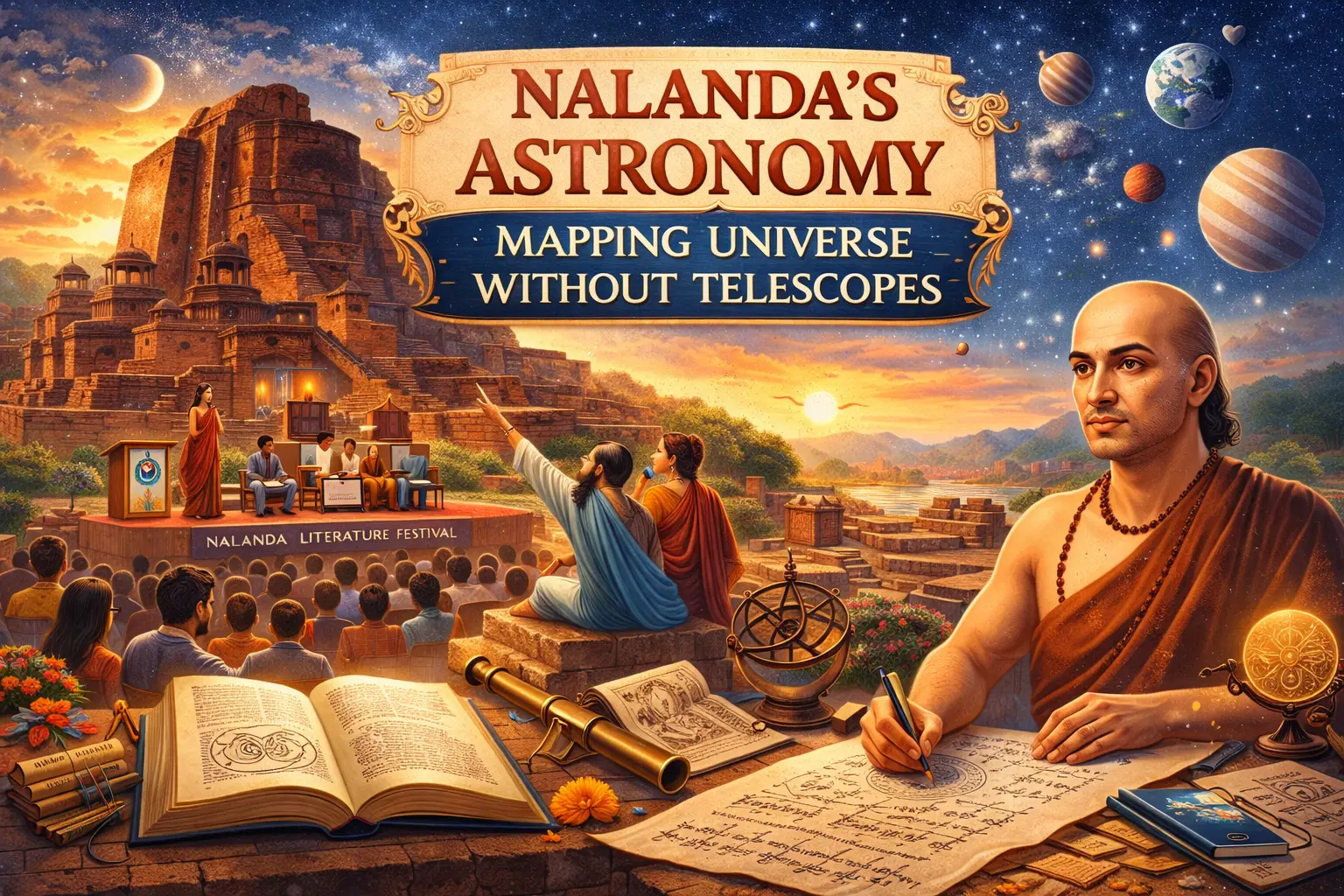
Nalanda’s Astronomy: Mapping Universe Without Telescopes
The
majority of people would associate the idea of astronomy with the use of
telescopes, computerised maps of the sky and the use of satellites to observe
the Earth. However, scholars in the ancient university of Nalanda Mahavihara in
India worked diligently and thoroughly without any such technology as we know
it today on determining the movements of planets, predicting when eclipses
would take place and estimating the year to within an astonishing degree. They
turned instead to mathematics, observation, discussion, and intellectual
rigour.
Today,
talks about this incredible scientific heritage are being rekindled at the
Nalanda Literature Festival, where history, knowledge, and imagination meet. It
is more than a book festival, a reminder in itself that the language of the
stars was once a language of storytelling.
Nalanda,
which existed between the 5th and 12th centuries CE, was one of the oldest
residential universities in the world. Though it is well known in the global
Buddhist philosophy tradition, its curriculum included grammar, medicine,
logic, mathematics, and astronomy.
Skies
that Shaped the Empire
According
to Xuanzang, the Nalanda Mahavihara had a lofty tower that may have been used
to observe heavenly objects and calculate the passage of time. This scientific
method was also practised in China by the Indian Astronomer Gautama Siddhartha,
who served as the chief of the Bureau of Astronomy from 665 to 698 AD during
the rule of Wu Zetian. He had administrative duties and was responsible for
administering the legal calendar and explaining the movement of celestial
bodies. The most astonishing thing is that his family had three generations
occupying the same prestigious position.
At
events such as the Nalanda Literature Festival, which is often considered one
of the best Book & Culture Festivals, these scientific traditions are not
only explored as facts of the past but as living stories. The universe itself
becomes a text, which the ancient scholars were able to read with ease.
Aryabhata
and the Rotating Earth
Aryabhata
was among the great minds whose ideas determined the intellectual atmosphere of
those times. He is credited in his magnum opus, the Aryabhatiya, with the
postulation of the rotation of the Earth on its axis, which could be another
millennium before it became more widely accepted in Europe.
Aryabhata
estimated the value of the solar year with uncanny precision. He described
eclipses as a phenomenon of the astronomical world, caused by shadows, going
beyond the mythological explanations of the time. His introduction of sine
tables and trigonometric calculations transformed the way astronomers
calculated celestial phenomena.
While
there is some debate about whether Aryabhata personally taught at Nalanda, his
ideas definitely influenced the intellectual circles of eastern India. His
mathematical model of astronomy was a part of the larger intellectual
environment that Nalanda and other institutions of learning fostered.
When
considered in the context of a contemporary Storytelling Festival that India
celebrates, Aryabhata’s contributions become more than just scientific – they
become storytelling drama. A thinker who looks at the same sky that we look at
today, but has the temerity to think of a moving Earth.
Observation
Without Instruments
Aryabhata
was able to accurately measure the heavens using astronomy much in the same way
as astronomers would use telescopes centuries later. He calculated what pi was
equal to as 3.1416, an extraordinary feat for the time. He calculated how many
times the Earth rotates around itself long before Copernicus and Galileo had
done so. Aryabhata's view of the universe was that it could be quantified, as
opposed to being viewed through mythological means. The best scientific
instrument that has ever been invented is the human mind.
A
century later, Brahmagupta improved upon Aryabhata’s ideas and developed rules
for arithmetic operations involving zero in his Brahmasphuṭasiddhanta, which
was translated into Arabic as Sindhind.
In
many ways, this scientific field is a perfect fit for the Youth Literature
Festival, where young minds are encouraged to think beyond assumptions. The
vision of Nalanda shows that curiosity and logic can light up even the darkest
skies.
Global
Knowledge Networks
Nalanda
was not a closed system. It was an international university well before the
word globalisation became fashionable. Scholars like Xuanzang (Hiuen Tsang) and
Yijing (I-Ching) travelled from China to study there and took manuscripts back
to Asia.
In
these interactions, knowledge on astronomy moved into and out of countries.
Indian
mathematical techniques spread to East Asia and later helped shape European
developments through Islamic transmission. Knowledge was like the stars –
networked and radiant.
This global aspect underlines why Nalanda Literature Festival is unique as a Book & Culture Festival with substance. It captures the same essence of sharing that characterised the ancient university.
Science
and Literature: Not Opposites
In
modern-day education systems, there is a tendency to have science and
humanities in different paths. However, an example of Nalanda gives a more
integrated model. Philosophy was made strong through logic. Cosmology was
supported by mathematics. Discussion polished knowledge.
It
is at what is arguably the Best Literature Festival in India that these
linkages are re-established. All this resonates with the spirit of Nalanda.
Message
to Next Generation
To
young attendees of the Youth Literature Festival events of the Nalanda
gathering, the poem of ancient astronomy provides a strong message: technology
should not be a barrier to imagination.
Nalanda’s
scholars lacked the telescopes such as those developed by Galileo Galilei. But
by the aid of reason, they were able to calculate heavenly facts with great
accuracy.
Innovation
does not start with equipment; it starts with questions.
Mapping
of Cosmos and Mind at Nalanda
The
Nalanda tradition of astronomy is more than a calculation. It is a mindset.
It
is concerning seeing up and questioning: Why has the sky changed? It is
concerned with the rejection of simple myths in favour of mathematical
argument. It is concerning the exchange of knowledge.
In
this respect, the astronomers of Nalanda were mapping two worlds at the same
time, the world above and the human mind's potential. This is why it is
particularly special to revisit this legacy at the Nalanda Literature Festival,
which is regarded by people as the Best Literature Festival in India.
Some
men and women were under the open sky, tracing shadows, computing angles, and
venturing to know the universe. Without the use of telescopes, they mapped the
universe. And with the advent of the Nalanda Literature Festival, such
remarkable stories continue to shine.
(0) Comments