Legacy in the Limelight: Roots of Panel Discussions in India
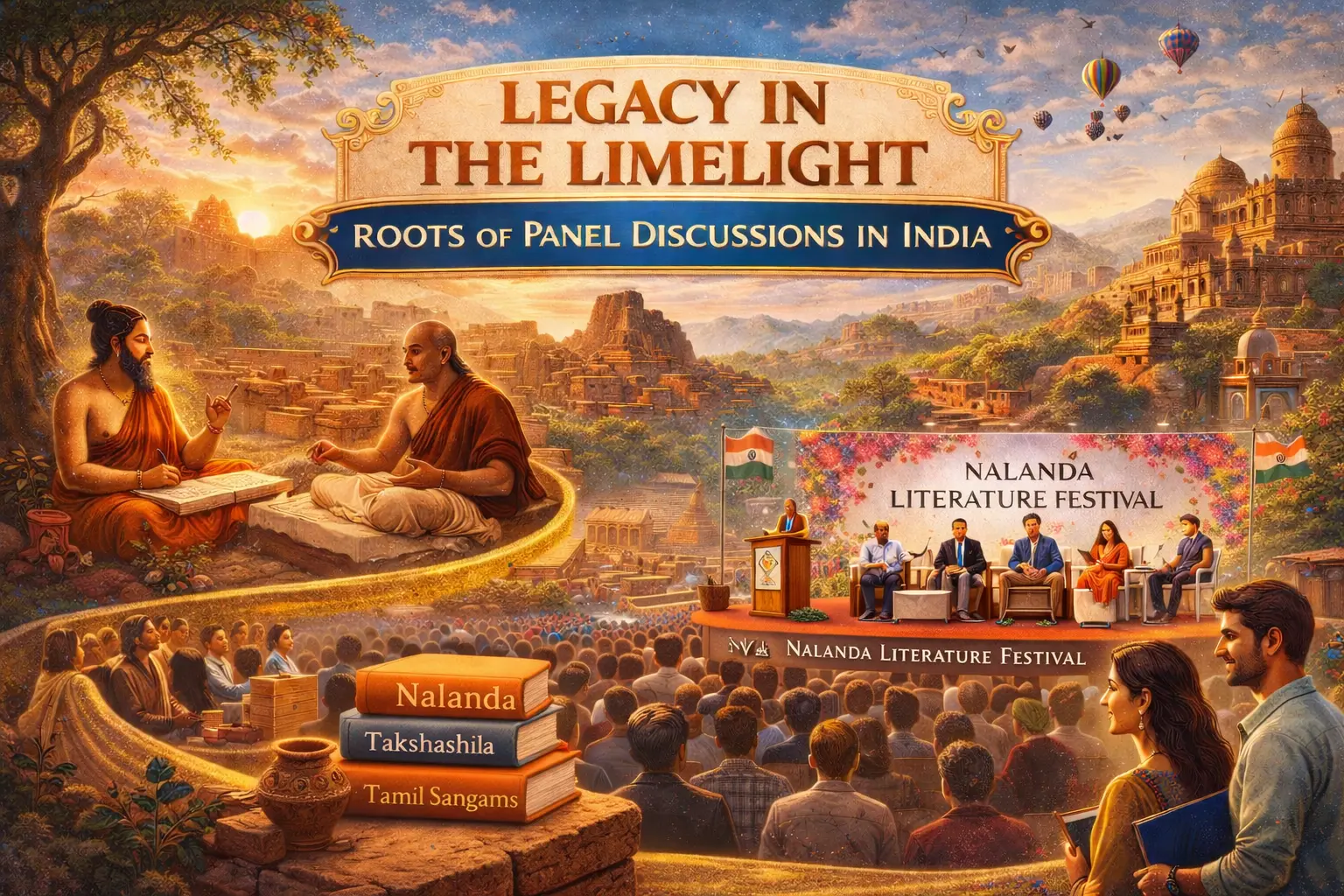
Legacy in the Limelight: Roots of Panel Discussions in India
From the ancient royal courts of the kings, to the
sun-soaked stages hosting panel discussions, India has nurtured the tradition
of intellectual debates and thoughts, tracing an age-old emphasis on sharing,
challenging, and celebrating knowledge and wisdom. Be it the magnificent
metaphysical debate on the nature of reality between the sage Yajnavalkya and
Gargi Vachaknavi that features in the third chapter of Brihadaranyaka
Upanishad, or the one between Adi Shankara and Mandana Mishra, encompassing a
discussion on the superiority of Advaita Vedanta versus Mimamsa
to attain Moksha, literary deliberations were deeply rooted in the idea
of scholarly critique, and were often staged as communal events.
The preeminent universities of Nalanda and Takshashila were
the epicenters of literary dialogues and discussions, and contributed oodles of
critical discourse on a plethora of domains. In an article titled, "In
Light of Nalanda," Namit Arora highlights the famous Chinese scholar
Xuanzang, who spent years learning from the Buddhist masters at Nalanda and was
very active in distinct academic convocations and discussions, reportedly
defeating over five hundred scholars in debates.
This enduring legacy of debating and discussing has now
transfigured into panel discussions that are an indispensable component of
literary events across India and the globe. The 2000s, which witnessed the
modern tradition of literary festivals in India, marked a major turning point.
The inception of the Jaipur Literature Festival in 2006 began a journey of
celebrating words, relished by authors and all literary enthusiasts. It later
evolved, and became a model for several other Indian literary festivals. Small
regional literary gatherings metamorphosed into large-scale international
events and collaborations, blending books with musical performances, cultural
events, and social debates. Panel discussions became the nucleus of these
events, curating conversations between writers, readers, critics, and
journalists, and were charged, lively, and crowded spaces. The essence of these
discussions being communal events was retained, making literary voices
accessible to the public.
These instances of scholarly ruminations are testimony of
our enduring legacy of collective information exchange. Human thought evolves,
progresses, and thrives through exhaustive dialogue. Panel discussions, that
are an extension of these literary discussions, affirm that collaborative
discourse fosters cognitive development. Although the versions of this
knowledge exchange have altered, they have stemmed from the aim of intellectual
advancement. The space and stage for discussion has shifted from the temple
steps to the glittery festival spotlight in the 21st century, but the ancient
flame of the Shaastrartha still burns. It proves that in India, the
greatest spectacle will always be retained in the idea of mutual knowledge
sharing.
(0) Comments