Youth, Ideas and Identity: The Role of Book and Culture Festivals in Contemporary India— A Case Study of Nalanda
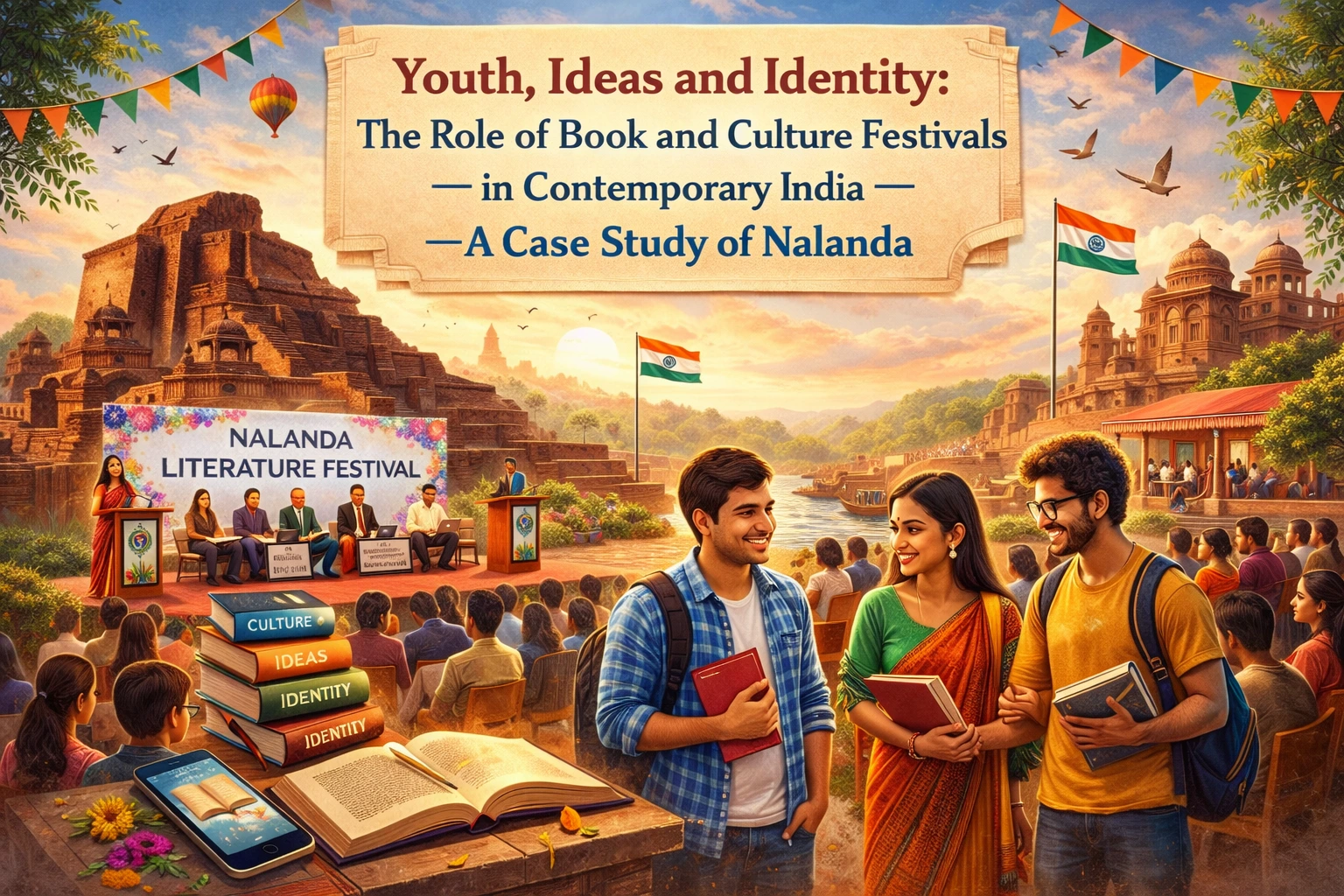
Youth, Ideas and Identity: The Role of Book and Culture Festivals in Contemporary India— A Case Study of Nalanda
In
a world of scrolling screens and shrinking attention spans, the resurgence of
intellectual public spaces has never been more relevant. In India, the Book and
Culture Festival phenomenon is more than just a literary event—it is the return
of dialogue, debate, and discovery. Among these new platforms, the Nalanda
Literature Festival is a compelling case study of the intersection of youth,
ideas, and identity in modern India.
Nalanda
is more than a geography; it is a memory of a civilisation. It was once the
site of the fabled Nalanda University, which represented the world’s
scholarship long before the word “globalisation” became the buzzword of the
day. Scholars from far-off lands, such as the Chinese monk Xuanzang, travelled
thousands of miles to participate in intellectual discourse at Nalanda. Today,
when a Book and Culture Festival is organised at Nalanda, it is more than a
series of panel discussions—it is a way of re-establishing a connection between
young India and its rich academic past.
For
young people, these festivals are a place of identity-building. In auditoriums
and in outdoor discussions, young people meet writers, historians, poets, and
policy analysts. They learn about disagreement without anger, about argument
without invective—qualities that are increasingly in short supply in today’s
divided online world. A Book and Culture Festival is a training ground for
democratic ideas.
Furthermore,
the backdrop of Nalanda makes the festival an experiential learning space. The
ruins serve as a reminder that the intellectual heritage of India existed
before the advent of colonial education systems and modern universities. This
awareness leads to a shift in identity, as the young audience starts to
identify themselves not only as consumers of global culture but also as the
inheritors of a strong intellectual tradition.
Another
critical aspect of the festival is representation. Regional languages, local
histories, and native narratives are given space alongside the dominant
discourse. By doing so, the festival fills the gap between the literary circles
of metropolitan India and the grassroots voices. Culture, in this case, is not
merely decorative; it is lived, discussed, and reinterpreted.
In
contemporary India, where identity is constructed between tradition and
ambition, Book and Culture Festivals have a subtle yet revolutionary impact.
They provide spaces for the youth to question, reclaim, and reinterpret who
they are. Nalanda, with its complex history and dynamic present, illustrates
how the strength of ideas continues to shape the collective consciousness of
the nation.
Finally,
festivals like these remind us that civilisations are sustained not only
through structures but through dialogues.
(0) Comments